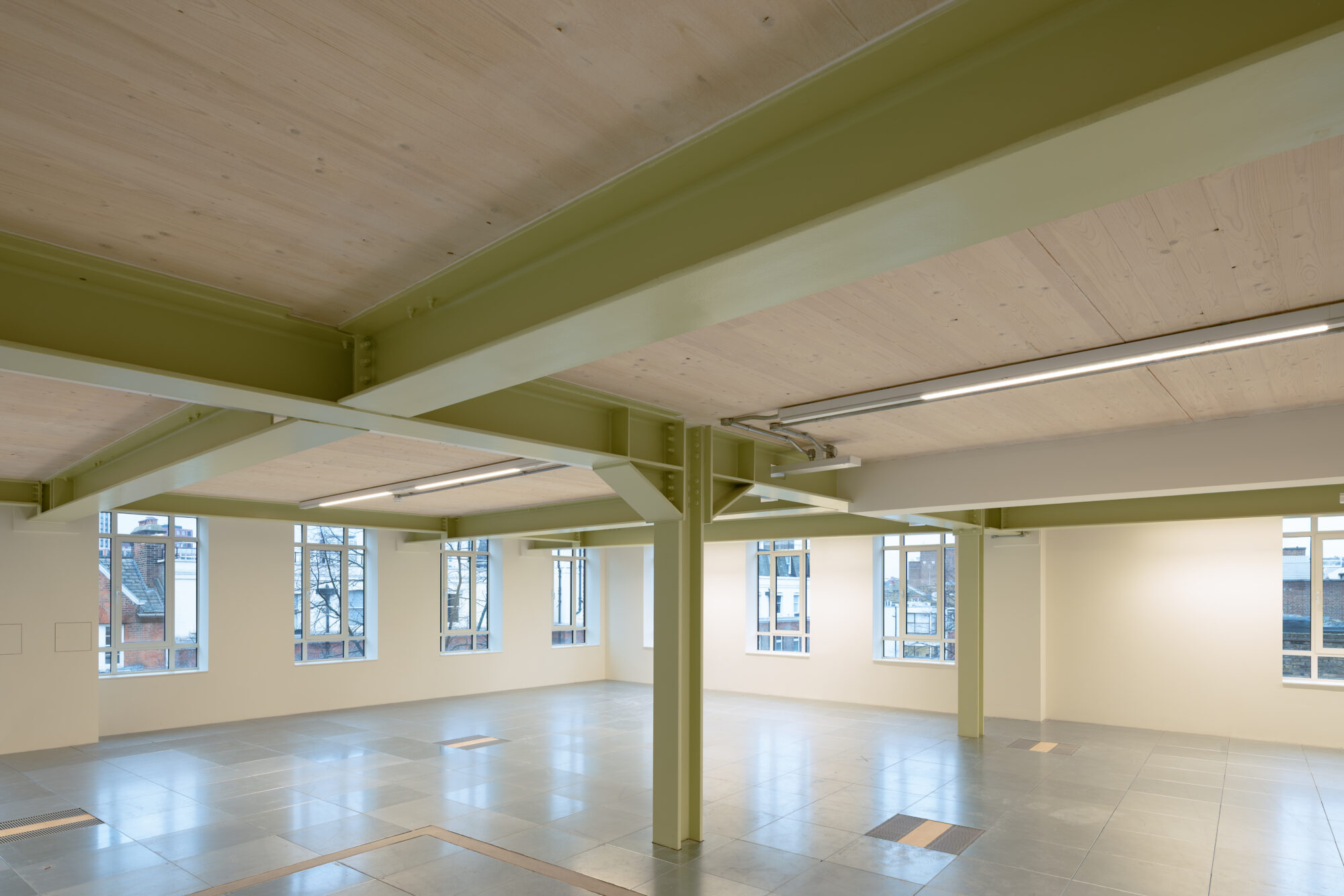


Waugh Thistleton Architects is set to fight a High Court trial in January as former client Vitsoe seeks £4 million in damages relating to a rotted timber roof
The practice worked as delivery architect for a 3,677m² factory-and-office complex in Leamington Spa from 2016. Now its former client, furniture-maker Vitsœ, blames the architect for rotted cross-laminated timber roof panels, which needed replacing.
Vitsœ alleges that Waugh Thistleton breached its contract by failing to ensure that the roof panels did not contain excessive moisture when they were sealed in by a vapour control layer. It claims this is what caused some panels to rot and lose structural integrity.
The manufacturer is seeking to recoup more than £4m it has spent on mending its roof, including construction and consultants’ costs, as well as interest paid on two multi-million-pound loans taken out to fund the remedial work.
However, Waugh Thistleton denies breaching its contract, saying that ‘the matters of which the claimant complains were the responsibility of others’. The architect points the finger towards the project’s construction manager, roofing contractor, and timber frame contractor, which are not part of the legal proceedings but had, the architect alleges, previously been sent pre-action protocol letters of claim by Vitsœ.
JCA Concept Construction was the project’s construction manager, Stoneleigh Services was roofing contractor, and Hess was the timber frame contractor. JCA was dissolved earlier this year and none of the companies are party to the trial.
The case was launched by Vitsœ in August 2022 and is scheduled to be heard in the Construction and Technology Court, part of the High Court, over eight days starting 20 January, after the parties failed to reach a settlement.
Contacted by the AJ, Waugh Thistleton’s insurer, Riverstone International, did not comment. The AJ understands that Waugh Thistleton is unable to comment while proceedings are active.
The claim
The roof of Vitsœ’s headquarters is mainly flat but central sections have a saw-tooth profile. The claim says the roof was originally built with 140mm CLT, topped by a vapour control layer, PIR insulation and a PVC roof membrane.
According to Vitsœ, Stoneleigh had been due to install the roof covering around two weeks after the timber frame and CLT roof had been completed by Hess. However, Hess ran ahead of schedule and ahead of Stoneleigh.
The timber frame was therefore finished in December 2016 but the roof covering was only finished in mid-March 2017, during which time the exposed CLT roof panels absorbed water, which was subsequently locked in by the vapour control layer, according to the claim.
Vitsœ alleges that Waugh Thistleton breached its contract by failing to produce a moisture content plan or risk assessment for the project.
It claims Waugh Thistleton ‘should have known that the roof timber would be susceptible to water damage during construction after the CLT had been laid but before the final PVC outer layer was applied’.
‘Despite the risks […], the defendant did not produce any moisture content control plan as described in [relevant] guidance or any other risk assessment addressing the risk of exposing the CLT to excessive moisture during the construction phase,’ it adds.
‘The only measure taken to mitigate this risk was that the works were programmed such that the roof covering works were concurrent with the timber roof construction works, with the roofing covering work following approximately two weeks behind the timber roof construction works.’
Vitsœ also alleges that Waugh Thistleton appraised contractors’ tenders but failed to identify that they contained no adequate plans for moisture protection during construction.
‘The defendant should have been aware that erection of a temporary shelter over the works area was the only reliable and effective way of protecting the works and should have advised the claimant that a temporary shelter was needed,’ the claim says.
Vitsœ also claims that Waugh Thistleton ‘failed to take any appropriate steps in response to the works not proceeding in accordance with the planned timetable, such that the CLT was exposed to sustained rainfall around Christmas 2016’.
It alleges the architect ought to have advised against the installation of the vapour control layer in wet conditions and instead should have recommended that a moisture sample was taken and a temporary canopy installed to permit the CLT to dry.
The defence
However in its submitted defence, Waugh Thistleton denies the allegations, saying that any issues with over-moist timber which led to rot ‘were not the responsibility of the defendant or attributable to any breach of contract or duty on the part of the defendant’.
The architect claims in the documents it was not responsible for the co-ordination of the contractors’ programmes, nor the protection of trade works during construction: ‘These matters were not part of the services which the defendant agreed to provide and were, instead, the responsibility of JCA, Hess and Stoneleigh.’
Waugh Thistleton says it did not produce a moisture content control plan nor assessment addressing the risk of CLT being exposed during construction, and denies that it was required to do so.
‘The responsibility for determining whether such a plan or assessment was required rested on JCA and the responsibility for providing any such plan or assessment rested upon JCA, Hess and/or Stoneleigh,’ it says in its defence.
Waugh Thistleton also denies that ‘the only reliable and effective way to protect the roof of the property during the construction phase was to erect a temporary shelter over the works area until the roof was rendered waterproof’.
Instead, it argues, ‘the proper sequencing of work, together with lesser temporary protections and the drying out of any areas which had suffered excessive exposure to moisture, would have been sufficient to protect the roof from damage from moisture during its construction.’
As well as denying liability for the alleged issues with the timber roof panels, Waugh Thistleton says it does not admit the property was built with CLT that contained excessive levels of water — although it acknowledges the roof has rotted in parts.
‘No admissions are made as to the extent of such rotting and decay or as to how and in what manner such rotting and decay came about and in particular as to whether such decay and rotting was caused by water being locked into the CLT when the VCL was applied,’ the defence says.
Contacted by the AJ, Hess’s general counsel, Christian Seller, said: ‘Hess is not a party to any legal action in relation to the [this] project. As such, Hess, is also not aware of any statements or allegations made by any of the parties in that litigation.
‘The only comment we’d like to make is that Hess has performed all of its works in accordance with the contract and in no way is Hess responsible for any damages incurred in connection with the project.’
Stoneleigh Services Limited, now known as Burrows Industrial Roofing Limited, could not be reached for comment.
Source: Dirk Lindner
Article source: Architects Journal