


Creating a modern co-working space within a 16th-century Grade II listed building is a careful exercise in balance. Contemporary expectations around durability, performance and finish must be met without undermining historic character. At Mount House in Dorking, Surrey, that balance has been achieved through the considered specification of birch plywood.
Southspace founder Matt Livey set out to create a flexible workspace for local creatives within the constraints of a protected heritage setting. Having previously worked with birch ply, he was drawn to the material for both its appearance and its adaptability. “We wanted to use materials that would sit happily in a historic location and, most importantly, age beautifully,” he explains.
After assessing a number of premium options, Livey specified WISA-Birch plywood, supplied by James Latham. The product’s long-grain finish and consistency made it suitable for a project where precision was critical, while its natural appearance allowed new interventions to complement rather than compete with the existing structure. “As soon as I saw WISA-Birch with its striking long grains, I wanted it to be the foundation of the material palette,” Livey says.
Birch plywood went beyond a purely background role within the fit-out, influencing colour choices and detailing throughout the space. “Its influence drove the wider design decisions and helped create the calm, cohesive atmosphere we were aiming for,” he adds. “It also finishes beautifully, whether you’re using oils, stains or varnishes.”
In total, 10 sheets of 18 mm birch plywood were supplied and fabricated locally using CNC processes. The panels were used to create desk surfaces, storage systems, pegboard walls and bespoke display elements. According to David Briggs, Birch Plywood expert at James Latham, the material’s structural performance was key. “What sets WISA apart is the manufacturing process,” he explains. “Each sheet is produced to EN636-2 and EN314-2 Class 3 standards, delivering dependable performance time after time.”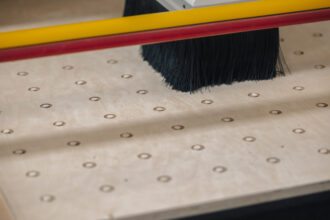
That performance was particularly important in a commercial workspace environment. “The robust cross-banding provides the strength and stability needed for multiple furniture and finishing applications,” Briggs adds, “especially where precision and durability are non-negotiable.”
Sustainability also influenced the specification. The birch plywood is PEFC certified, manufactured in Europe and meets E1 formaldehyde emission requirements, supporting healthy indoor air quality. Offcuts generated during fabrication were reused across secondary features, reinforcing a low-waste approach.
Completed in late 2025, Southspace demonstrates how carefully specified timber products can bridge heritage and contemporary use. “It captures what can be achieved when you push plywood to its limits in an unusual space,” Livey concludes. “The material, and the technical support behind it, made that possible.”