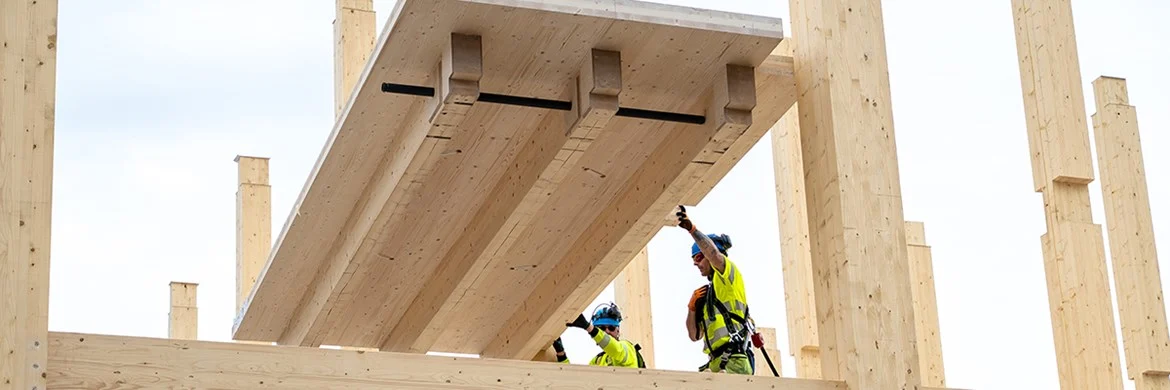


Willmott Dixon has commissioned comprehensive fire safety tests for cavity barriers on CLT to eliminate a technical gap that has created uncertainty and delays on CLT projects. The testing programme, which Willmott Dixon did in partnership with passive fire protection specialist Siderise and CLT manufacturer KLH, provides the industry with certified solutions for projects using CLT and Siderise cavity barriers in both wall and floor applications. Previously, all projects would have required individual technical assessments.
Conducted at Siderise’s Innovation Centre in Maesteg, the tests examined three critical interface scenarios that appear across CLT construction projects:
- CLT wall interfaces in vertical configuration with EW-CB 30 Cavity Barrier (tested to EN1366-4)
- CLT floor and wall interfaces in horizontal configuration with EW-CB 30 Cavity Barrier (tested to EN1366-4)
- CLT floor and wall interfaces in horizontal configuration with RH25 90/30 Cavity Barrier for rainscreen applications (tested to TGD19 prEN1364-6).
All three tests passed successfully, covering worst-case scenarios including 100mm fivelayer CLT panels tested to rigorous European standards. The absence of standardised testing for cavity barriers on CLT has meant that every project required bespoke technical assessments, creating inefficiency in design processes and uncertainty around fire safety performance. The new test data provides design teams across the sector with certified solutions that can be specified with confidence.
“This testing addresses a genuine technical gap that affects every organisation working with CLT,” said Jessica Winyard, Architectural Technologist at Willmott Dixon. “By working collaboratively with Siderise and KLH to develop these solutions, we’re helping to accelerate the adoption of low-carbon construction methods while ensuring robust fire safety performance.”
For architects, engineers and contractors working on CLT projects, the implications are immediate and practical including: standard cavity barrier details can now be specified without project-specific fire testing, design programmes are streamlined, removing delays associated with bespoke assessments, fire safety performance is backed by certified test evidence to EN1366-4 and prEN1364-6 standards and risk is reduced through proven solutions for vertical walls, horizontal floors and rainscreen applications Chris Mort, Director of Testing & Project Engineering at Siderise said: “One of the primary goals of investing in the Siderise Innovation Centre was to provide the industry with the means to back their designs with robust test data, helping them achieve compliance and deliver safer buildings without compromising on design. We were delighted to support Willmott Dixon with the development of standard details for the CLT projects, and our learning from this process has been invaluable for expanding our own understanding of the demands of such an innovative structural system.”
The availability of tested certified solutions for CLT cavity barriers removes a significant barrier to the wider adoption of CLT in construction projects. With these tests complete and results now available to the industry, CLT projects can proceed with greater confidence and efficiency, supporting the sector’s transition to lower-carbon construction methods while ensuring robust fire protection in concealed space.