

Grown in Britain today announces the launch of the Biogenic Stored Carbon Quotient (BSCQ), the UK’s first certification scheme to quantify and independently verify the long-term carbon stored in buildings using timber and other biogenic materials.
The scheme has been developed in direct response to the UK Government’s Timber in Construction Roadmap and their Timber Industrial Strategy, in partnership with Timber Development UK, Bangor University, the Forestry Commission, Welsh Government, Scottish Forestry and industry leaders.
The Climate Case for Action
The construction sector is responsible for 39% of global emissions. The infrastructure the world needs to build between now and 2050 is equivalent to everything built since 1850. And if we continue using traditional high-carbon materials with a high carbon footprint, that alone will consume most of the remaining carbon budget for keeping global temperature increases below 1.5°C.
Nature has already provided a solution. Plants and trees absorb CO₂ as they grow, and when we build with them, that carbon remains locked out of the atmosphere for the lifetime of the building. Every project that specifies timber or other biogenic materials is already storing carbon. But until now, that contribution has been invisible: absent from tenders, Environmental, Social and Governance (ESG) reports, corporate accounts and conversations with shareholders and clients. BSCQ changes that.
“The climate emergency demands that we build differently – and the construction sector is already rising to that challenge. But without the tools to measure and verify what’s being achieved, that progress remains unaccounted for.
BSCQ gives the sector a credible, independently verified way to demonstrate the climate contribution of its material choices, and to prepare for a future where that contribution carries real commercial and policy value.”
Dougal Driver, CEO, Grown in Britain
What Biogenic Stored Carbon Quotient (BSCQ) Delivers
BSCQ provides construction projects with a certified, publicly registered record of the biogenic carbon stored in their buildings, covering all biogenic materials where sufficient data is available, including timber, sheep’s wool, straw and hemp.
For developers, contractors and public bodies, BSCQ delivers four things that current carbon assessment frameworks cannot:
- An independently verified stored carbon figure from a third party* that sits alongside embodied carbon data in project reporting and corporate accounts.
- An auditable basis for ESG reporting credible verification that can be put in front of a board, an investor or a procurement panel with confidence.
- Positioning for emerging carbon credit mechanisms. Certified stored carbon can be prepared for future monetisation on the voluntary carbon market.
- A verified record that supports competitive tendering including requirements now appearing in Department for Education contractor frameworks.
“ This scheme will clearly demonstrate the positive environmental impact of projects like Gwynfaen. The biobased material choices not only provide healthy places for people to live but act as a long term carbon store for decades to come.”
Justyna Wilkinson, Associate Architect at Stride Treglown
The Role of Grown in Britain (GiB) Certified Timber
Whilst both imported and homegrown timber are included in the scheme, each BSCQ-certified project must include an element of GiB-certified timber, reflecting the ambition of the UK and the devolved Government’s ambition, to increase the use of homegrown timber in construction.
GiB-certified timber has a demonstrably lower carbon footprint than imported equivalents, as evidenced by Timber Development UK’s independently verified Environmental Product Declaration (EPD) data. Grown in Britain is the only certification scheme to verify the legality, sustainability and provenance of UK timber, and holds Category A status under the UK Government’s Timber Procurement Policy.
The UK is currently the second largest net importer of timber products in the world, and approximately 40% of UK woodlands are under-managed. Greater demand for GiB-certified timber – driven by BSCQ – creates a direct incentive to bring more woodland into active, sustainable management, with benefits for biodiversity, productivity, employment and long-term carbon sequestration.
“This certification scheme is a game-changer.
It enables the construction sector to move beyond emissions reduction and embrace carbon storage as a strategic climate solution. Timber buildings are not just low-carbon—they store carbon in the long term. And now, we can prove it.”
Matthew Riddiford, Carbon Plantations
Full details of the BSCQ scheme, including the standard and supporting documentation, are available at https://www.growninbritain.org/certification/biogenic-stored-carbon-quotient/
*Independent auditing and certification of BSCQ are carried out by Supply Chain Insites Ltd. whose deep expertise and innovative strategies, are driving change in certification globally. Their skills and experience will ensure robust compliance for BSCQ ensuring its lasting impact.
Examples of BSCQ Projects:
BSCQ Project 1
Client: Forestry England
Contractor: Willmott Dixon
Project: Vernon Stockton Seed Centre, Delamere, Cheshire
Type: Commercial
BSCQ Certified Score: 614,030 kgCO²e
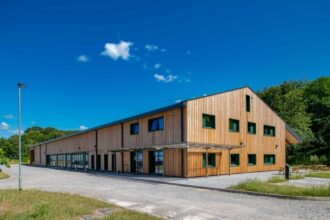
Forestry England’s new seed processing centre at Delamere in Cheshire provides a cutting-edge facility which supports the creation of climate-resilient forests for future generations and strengthens the UK’s forestry infrastructure.
The requirements for the centre dictated an innovative approach, as the space needed a large, unobstructed workspace for flexible equipment positioning and efficient seed processing. Steel construction would have required multiple purlins throughout the span, cluttering the space and reducing the sense of openness.
The solution came through the main contractors, Willmott Dixon, collaborating with GiB certificate-holders Buckland Timber, to create a design using pitched, curved glulam beams that are wider in the middle, where strength is needed most. CLT panels were then used to span between the main frames, negating the need for purlins and creating an entirely open workspace with minimal visible structure.
These beams – at 18 metres long with a curved profile – needed precision manufacturing and were made at Buckland’s factory in Devon, reducing transport mileage considerably compared to importing similar curved elements. The exterior was clad in Grown in Britain (GiB) certified larch, which also provides weather protection.
Forestry Minister Mary Creagh formally opened the new timber-framed, net zero building, which is the largest such facility in the UK and represents a major investment in the UK’s forestry sector. It has capacity to store up to four tonnes of high quality tree seeds each year in climate-controlled conditions. It supplies seed to be grown in Forestry England’s own nursery and to private and public forestry organisations across the UK, growing 6.7 million trees in 2024/25 and dispatching 5.3 million trees for planting in the nation’s 1,500 forests.
BSCQ Project 2
Client: Pobl & Welsh Government
Architect: Stride Treglown
Main contractor: Hale Construction
Project: Gwynfaen Housing Project
Type: Residential affordable housing
BSCQ Design Phase application submitted: 3,480,635 kgCO²e
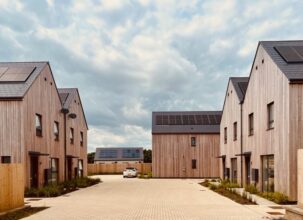
The Gwynfaen Project has been designed by Stride Treglown Architects with a timber-first approach using modern methods of construction.
The development features 144 timber frame homes arranged around a natural landscape, with a village green and community hub at its heart. The design draws on the historic settlements and natural beauty of the Gower Peninsula, using local timber and cladding sourced from sustainable woodlands. Gwynfaen demonstrates how a new housing development can prioritise timber and modern methods of construction to reduce emissions and store carbon over the long term.
With its focus on local sourcing and the use of natural materials in both the frame and insulation, Gwynfaen was likely to deliver a high stored carbon score, making it a natural choice to put through the new Biogenic Stored Carbon Quotient.
Working closely with local manufacturer, SO Modular, each home comprises a ‘kit-of-parts’- made up of pre-insulated wall panels, floor panels, and roof cassettes using wood fibre – this reduces embodied carbon, cuts waste, speeds up construction, and allows air-tightness detailing to be done in a controlled environment to help the homes meet their ambitious energy targets.
The project has achieved ‘combustion-free living’ through passive design, energy-efficiency measures, and a high-performance building fabric, reducing overall energy demand. The highly insulated timber-framed wall and roof panels were manufactured off-site, and a bio-based insulation replaces more common oil-based polymers with wood fibre and cellulose (recycled newspaper).
With a focus on local supply chains, the roof, floor and wall panels and cassettes have used C16 timber, shortening supply chains, boosting the local economy and reducing risk. This local procurement model drives investment in Welsh woodlands, securing sustainable future management and ongoing timber supplies.
Aiming for completion in July 2026, the project has already won numerous awards, including Best Development and the Structural Timber Pioneer Award.