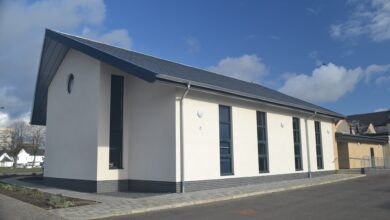


Installing air and vapour control layers need careful consideration. A.Proctor provide some expert advice on how to approach this critical aspect of timber construction.
A critical aspect of condensation control in buildings is restricting the passage of moisture vapour from the building’s interior into the external walls and roof. A membrane layer, installed behind the internal finish, is designed to perform that function.
Traditionally called a vapour control layer (VCL), these membranes are now known as air and vapour control layers (AVCLs) to reflect the important role they play in also slowing the loss of warm air from the heated spaces. All AVCLs need to be a well-sealed, continuous layer. A high standard of installation is essential, with care taken to seal all laps, penetrations, perimeters, junctions, and accidental punctures.
Does it matter which way round AVCLs are installed?
In terms of an AVCL’s core function of providing air and vapour resistance, there is no ‘correct’ side that should face the building’s interior. Many AVCLs offer specific secondary performance characteristics, which often do require the membrane to be installed with one face in a particular direction. Reflective membranes must face an empty cavity to provide the intended boost to thermal performance, while fire-rated membranes need to face the expected source of a fire.
Products can also be designed with health and safety in mind. For example, the Profoil 861 membrane is offered for high humidity applications which may often be externally installed on a roof, e.g. metal decking. It has one silver face and one blue face, with the blue face designed to prevent workers on the roof suffering from glare or dazzle.
What is the best way to install an AVCL on SFS stud frames?
Unlike a timber framed building, it’s not possible to simply staple an AVCL membrane to a steel stud. If mechanical fixing is desirable or preferred then a suitable flat- or wafer-headed fixing, with a washer-type head, should be used. Where mechanical fixings could affect the evenness of the internal lining, then an alternative is to use a double-sided tape like Probreathe® FR Duo Tape. Depending on the building’s fire strategy, a butyl tape i.e. Probond Tape may also be an option.
What are the minimum fixing requirements for AVCLs?
In their typical position behind the internal lining, AVCLs are fully secured to the substrate when the lining is fixed. The initial fixing of the AVCL is therefore only a temporary fix, and so specific fixing centres or double-sided tape coverage don’t need to be observed. It might be enough to use mechanical fixings at the top, bottom and mid-point of the AVCL length. Where a tape like Probreathe FR Duo Tape is used, it can be applied in full strips, or use 100mm sections at intermittent centres.
Where an AVCL is used in a self-weighted situation – such as a ceiling – then it can be adhered, but some mechanical fixings should also be included as part of the temporary works. If the AVCL is likely to be left exposed for a length of time before the internal lining is fixed, then the choice of temporary fixing should reflect that to avoid leaving edges unsecured and minimise the risk of damage.
Image: Careful consideration should be given to the installation of AVCLs